How does facial recognition work?
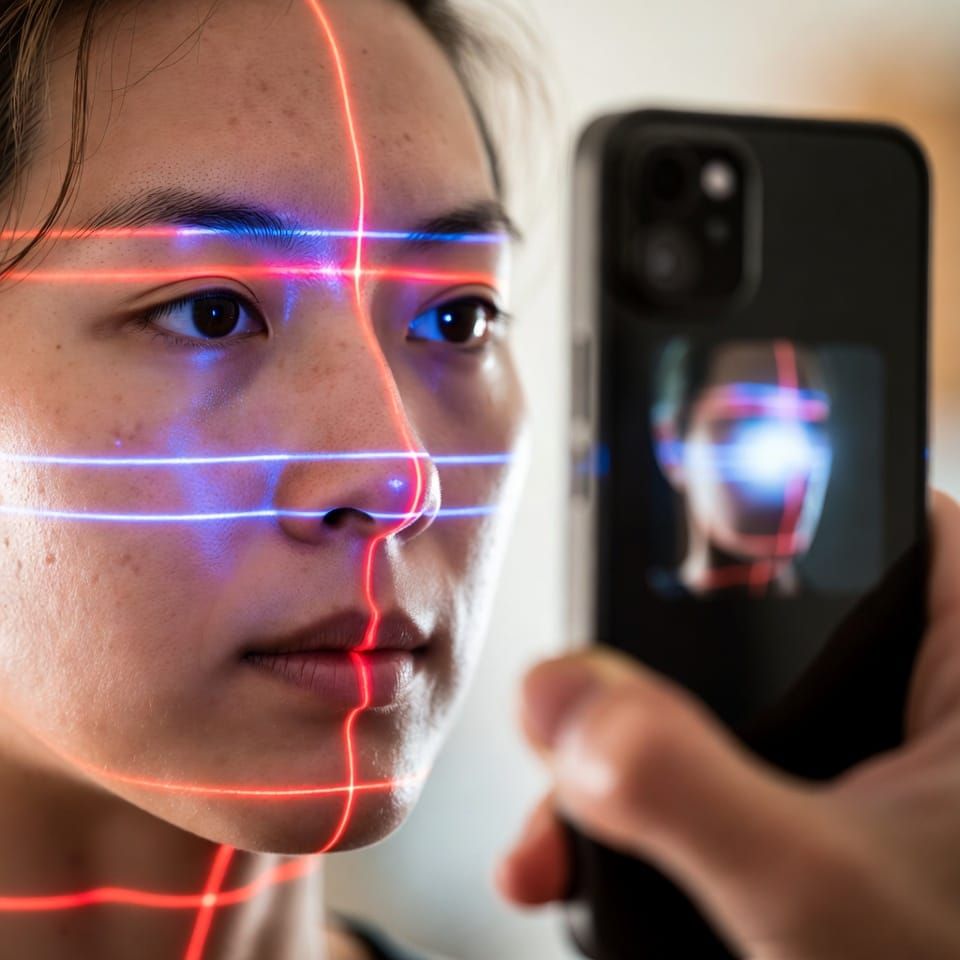
Facial recognition is a biometric technology that identifies or verifies a person's identity by analyzing and comparing facial features from digital images or video frames against a database of known faces. It is contactless, widely used in security, authentication, surveillance, and consumer devices, and relies on AI, machine learning, and computer vision.
How Facial Recognition Works (Core Process)
The system typically follows these steps:
- Face Detection — Locates and isolates faces in an image or video, even in crowds or varied conditions (using algorithms like Haar cascades, HOG, or CNNs).
- Face Alignment/Normalization — Adjusts for pose, lighting, scale, and angle to standardize the image.
- Feature Extraction — Maps key landmarks (e.g., distance between eyes, nose shape, jawline, cheekbones) and converts them into a mathematical representation called a face embedding, template, or feature vector (often a high-dimensional numerical vector).
- Matching/Comparison — Compares the template to stored ones in a database for verification (1:1 match, e.g., unlocking a phone) or identification (1:many search). Similarity scores determine matches, with thresholds for acceptance.
Modern systems use deep learning (Convolutional Neural Networks or CNNs) trained on massive datasets for higher accuracy and robustness to variations like lighting, expressions, or partial occlusions.
Software Components
- Algorithms and Models — Traditional geometric (feature-based) or holistic (whole-face) methods, now dominated by deep neural networks (e.g., FaceNet, ArcFace). These generate embeddings for comparison.
- Key Capabilities — Liveness detection (to prevent spoofs like photos or masks), anti-spoofing, emotion/age/gender analysis, and real-time processing.
- Popular Software/Platforms (as of 2026):
- Cloud: Amazon Rekognition, Microsoft Azure Face API, Google Cloud Vision.
- SDKs/Libraries: Banuba Face AR SDK, NEC, HyperVerge, Face++, Megvii, 3DiVi.
- Enterprise/Surveillance: Avigilon, BriefCam, Paravision.
- Open-source/embedded: Often based on models like MTCNN for detection or MobileNet for efficiency.
Software can run on-device (edge), in the cloud, or hybrid setups for privacy, speed, and scalability.
Hardware Components
Hardware captures high-quality input and accelerates processing:
- Cameras/Sensors:
- Standard RGB cameras (surveillance, webcams).
- Depth/IR cameras for 3D mapping and liveness (e.g., Apple's Face ID uses a TrueDepth camera with infrared dot projector and reader for 30,000+ points).
- Specialized facial recognition cameras with built-in AI for edge detection and quality checks.
- Processors:
- CPUs/GPUs for heavy computation (servers/desktops).
- NPUs (Neural Processing Units) or AI accelerators (e.g., in smartphones like Apple's Neural Engine, Snapdragon, or Nvidia Jetson) for efficient on-device inference.
- Embedded ARM processors for low-power devices (kiosks, access control).
- Other — Storage for databases, networking for cloud integration, and sometimes specialized chips for cryptographic security (e.g., Secure Enclave in devices).
Systems range from simple smartphone unlock (edge processing) to large-scale surveillance (server/cloud with high-res cameras).
Applications and Considerations
Common uses include smartphone unlocking, airport security, law enforcement, attendance systems, and payment authentication. Accuracy has improved dramatically but can be affected by lighting, pose, image quality, occlusions, or biases in training data. Privacy, ethical concerns, and regulations (e.g., GDPR) are key ongoing issues.
Facial recognition continues to evolve with better AI models, edge computing, and 3D/depth sensing for higher security and usability.