Why does a gyroscope maintain its balance?
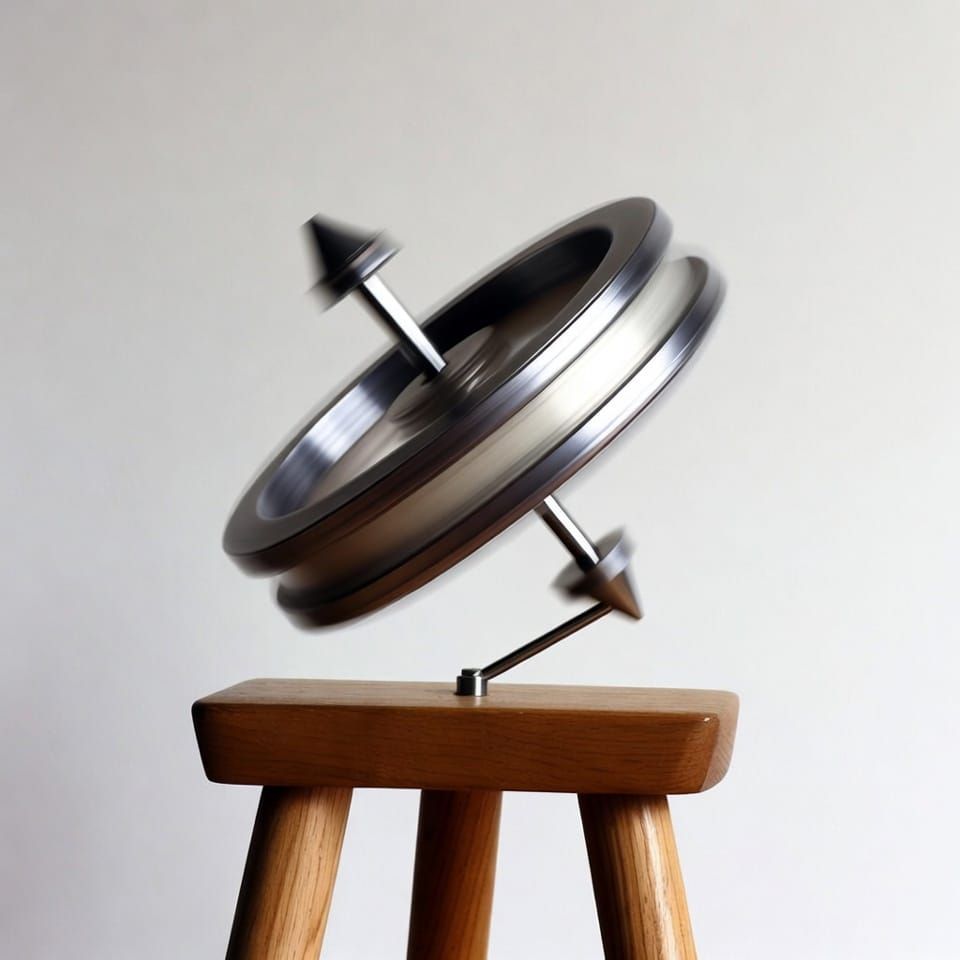
A gyroscope maintains its balance (or more precisely, its orientation) primarily due to the conservation of angular momentum. This is a fundamental principle of physics: when no external torque (rotational force) acts on a system, its angular momentum—a vector quantity that combines the object's rotational speed, mass distribution, and axis direction—remains constant in both magnitude and direction.
Simple Analogy
Think of a spinning bicycle wheel or a toy top. Once it's spinning rapidly, it "wants" to keep its spin axis pointing in the same direction, resisting attempts to tilt or reorient it. This resistance is often called gyroscopic rigidity or rigidity in space. The faster and heavier the spinning part (the rotor or wheel), the stronger this effect.
Why This Happens
- Angular momentum (L) for a spinning object is roughly L = I × ω, where I is the moment of inertia (how the mass is distributed away from the axis) and ω is the angular velocity (spin rate and direction).
- The direction of L aligns with the spin axis.
- If you try to tilt the gyroscope (applying a torque perpendicular to the spin axis), Newton's laws for rotation say torque equals the rate of change of angular momentum (τ = dL/dt). Without torque, L doesn't change direction.
- As a result, the gyroscope's axis stays fixed relative to an inertial reference frame (like distant stars), even if you move the outer frame or mounting around it.
This is why a handheld gyroscope can seem to "balance" defiantly on a string or edge while spinning—it resists falling over or changing tilt.
What About Precession (the "Wobbling")?
When an external torque does act (e.g., gravity trying to topple a leaning gyroscope or spinning top), the axis doesn't fall straight down. Instead, it precesses—it slowly rotates around a vertical axis. This happens because the torque changes the direction of L (not its magnitude), causing the tip of the angular momentum vector to trace a circle. The precession rate depends on the torque strength, the spin speed, and the moment of inertia.
In short: no torque → perfect stability of orientation. With torque → smooth precession instead of tipping over.
Everyday Examples
- Bicycle/motorcycle wheels → Their spin contributes to stability (though other factors like steering geometry play a bigger role at low speeds).
- Spinning tops → They stay upright longer when spinning fast.
- Smartphones and drones → Use tiny MEMS gyroscopes (based on the same principle) for orientation sensing.
- Aircraft and spacecraft → Gyroscopes help maintain heading and attitude.
The effect is strongest with high spin rates and mass concentrated far from the axis (like a heavy rim on a wheel). If the gyroscope isn't spinning (or spins too slowly), it behaves like any ordinary object and topples easily—no special "balance."
This phenomenon doesn't violate gravity or other laws; it's just rotational inertia in action, analogous to how linear momentum keeps a moving object going straight unless pushed. Experiments with bicycle-wheel gyroscopes (hung from a string or held on a pivot) beautifully demonstrate both the resistance to tilting and the precession when gravity applies torque.