How do birds ride rising air currents?
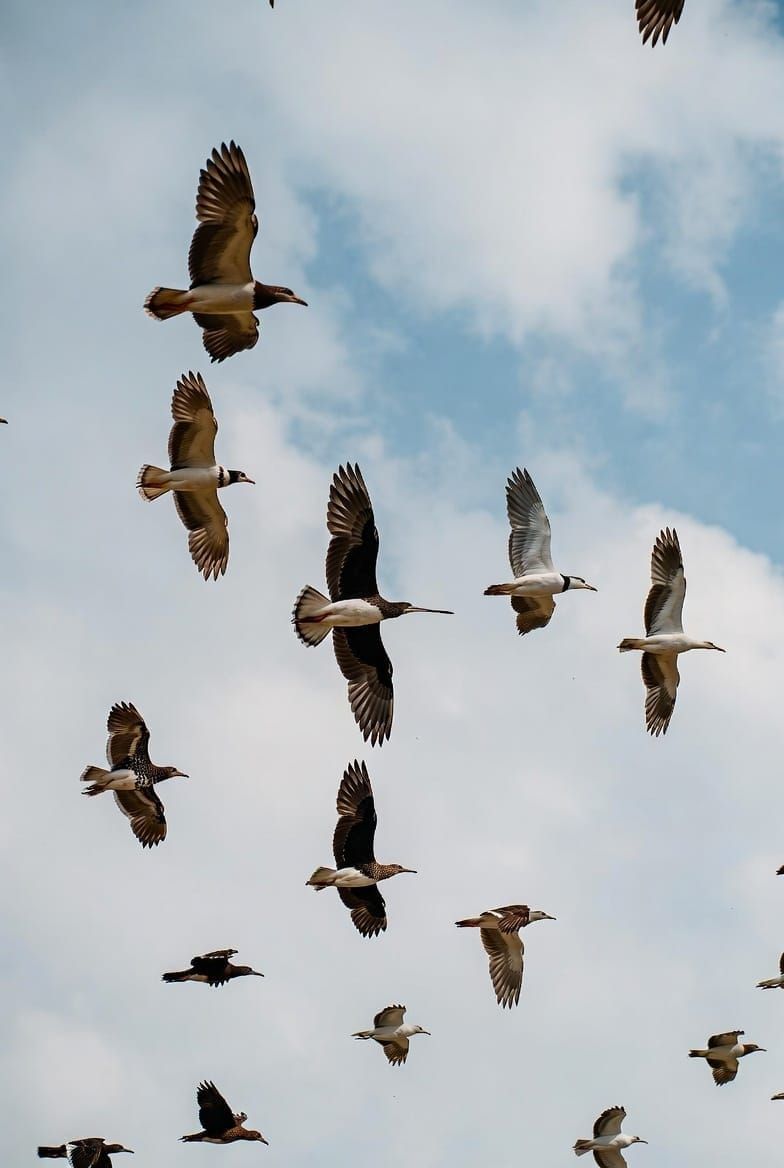
The ability of a bird to ride rising air currents (known as soaring or gliding without much flapping) is strongly related to its wing size and shape, but different birds also use their wings in distinct ways and exploit different types of rising air currents. It's not one-size-fits-all—God created tailored wing designs and flight techniques to specific environments, habitats, and behaviors.
Key Factors: Wing Size and Shape
Two main metrics determine soaring efficiency:
- Aspect ratio — Wingspan divided by average wing width (or squared wingspan divided by wing area). High aspect ratio = long, narrow wings (efficient for low drag and long-distance gliding). Low aspect ratio = shorter, broader wings (better for slow, maneuverable flight and tight turns).
- Wing loading — Bird's weight divided by wing area. Low wing loading (large wings relative to body weight) allows slower flight and easier lift in weak updrafts.
These traits directly influence how well a bird can stay aloft on rising air.
Different Wing Types for Different Soaring Strategies
Birds are often grouped into soaring wing categories:
- Passive Soaring Wings (short-to-medium, broad wings with slotted primary feathers that spread like fingers):
- Examples: Eagles, hawks, vultures, storks.
- Best for thermal soaring (riding columns of warm, rising air created when the sun heats the ground unevenly).
- How they use them: They circle tightly inside thermals to stay in the rising bubble, often at slow speeds. The slots reduce drag at low speeds while maintaining lift and allowing precise maneuvering. They can gain altitude like an elevator, then glide to the next thermal.
- Why the shape works: Broad wings with low wing loading let them fly slowly without stalling, perfect for inland areas with patchy thermals.
- Active Soaring / Dynamic Soaring Wings (long, narrow, high-aspect-ratio wings):
- Examples: Albatrosses, gulls, shearwaters, frigatebirds.
- Best for dynamic soaring or slope/ridge soaring over oceans or waves (exploiting wind speed differences near the surface vs. higher up, or updrafts from waves/mountains).
- How they use them: They zigzag or loop in a figure-eight pattern, diving into slower wind near the water and climbing into faster wind above to gain energy from wind shear. This lets some species (like wandering albatrosses) fly for days or thousands of miles with almost no flapping.
- Why the shape works: High aspect ratio minimizes drag for efficient gliding in steady winds; they are less reliant on thermals and more on consistent horizontal wind gradients.
Other birds (e.g., falcons) have high-speed, pointed wings and rely more on flapping or powered flight, soaring less often.
Additional Techniques and Behaviors
Beyond wing design, birds actively adjust how they use their wings:
- Circling vs. straight gliding — Thermal soarers (eagles/vultures) bank and circle; dynamic soarers (albatrosses) use S-turns or loops.
- Wing positioning — Some hold wings in a shallow V (dihedral) for stability (e.g., vultures often fly with a strong dihedral).
- Feather adjustments — Spreading or slotting primaries fine-tunes lift and drag in real time.
- Combining lift types — Many birds switch between thermals, ridge lift (wind deflected upward by hills), and dynamic soaring depending on conditions.
Larger birds generally soar more efficiently because scaling laws favor them (bigger wings relative to weight in many cases), but even within similar sizes, shape and technique matter hugely.
Wing size and shape are the foundation—they determine the "hardware" that makes certain soaring styles possible or efficient. But different birds have evolved specialized "software" (flight behaviors and techniques) to match their wing type to the available air currents in their environment. A vulture's broad, slotted wings would be inefficient for an albatross over the open ocean, and vice versa.
This combination of morphology and behavior allows birds like turkey vultures to circle for hours scanning for carrion, or wandering albatrosses to cross vast oceans with minimal energy.