When did football referees start using the penalty flag?
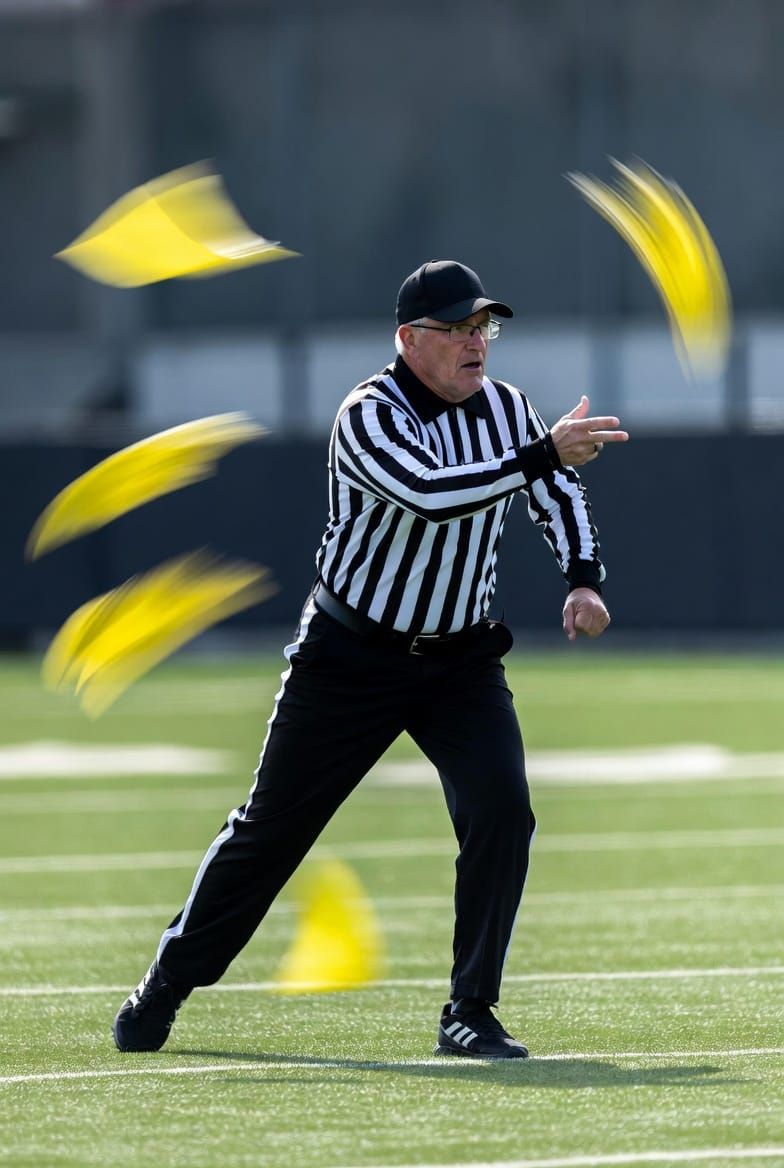
Football referees (officials) throw a yellow penalty flag to indicate a foul for several practical and visual reasons that make it effective in a fast-moving, outdoor sport:
- Clear, instant visual signal: The bright yellow (or gold) cloth stands out sharply against the green field, white lines, player uniforms, and grass/turf. Players, coaches, fans in the stands, and TV viewers can immediately see that a penalty has been called, even from a distance or in crowded action.
- Does not stop play prematurely: Officials throw the flag while allowing the play to continue (especially for live-ball fouls). This prevents confusion about whether the down is over. After the play ends, the flag on the ground marks the approximate spot of the infraction, helping with enforcement and discussions between officials.
- Distinguishable from other signals: Before flags, officials relied mainly on whistles or horns, which could blend into crowd noise or be misinterpreted. The thrown flag is a unique, unmistakable action. It is also weighted (often with sand or beans) so it can be tossed accurately over long distances without blowing away easily.
- Practical advantages over alternatives:
- Whistles/horns alone are auditory and can get lost in stadium noise; multiple whistles could cause chaos.
- Raising a hand or arm is used for other signals (e.g., incomplete pass, touchdown).
- Throwing a hat is reserved for specific situations, like marking a spot when an official has already thrown their primary flag (e.g., a second foul or out-of-bounds marker). Using hats routinely would create confusion.
- Other objects (like paper) could drift or be hard to spot. The flag's color and weight solve these issues.
In short, the flag is a simple, reliable, highly visible way to communicate "foul observed—play continues, but there will be a penalty" without disrupting the flow of the game too early.
When Did Referees Start Using the Penalty Flag?
The penalty flag is a relatively modern invention in American football:
- Origin (1941): The idea came from Dwight "Dike" Beede, head coach at Youngstown College (now Youngstown State University). Frustrated with unclear penalty signals, he had his wife, Irma, make the first flags from a bed sheet and material from an old Halloween costume. The first penalty flag was thrown on October 17, 1941, during a college game between Youngstown College and Oklahoma City University. It replaced (or supplemented) the previous method of using only whistles or horns to signal infractions.
- Official adoption (1948): The flag gained widespread acceptance at the 1948 American Football Coaches Association rules meeting. It was then adopted across college and high school football.
- NFL debut (1948): The National Football League first used penalty flags on September 17, 1948, in a game between the Green Bay Packers and Boston Yanks (played at Fenway Park).
Evolution of the Flag's Appearance
- Early flags were often white (in the NFL until 1965) or red (in college until the 1970s).
- In 1965, the NFL switched to the now-familiar bright yellow/gold color for better visibility (this change happened even though most TV broadcasts were still black-and-white at the time). College and other levels soon followed.
Today, the yellow penalty flag is a universal symbol in American football (NFL, college, high school, etc.), and the phrase "flag on the play" is instantly recognized by fans. The system has remained largely unchanged for over 75 years because it works so effectively.