How does a space tether work?
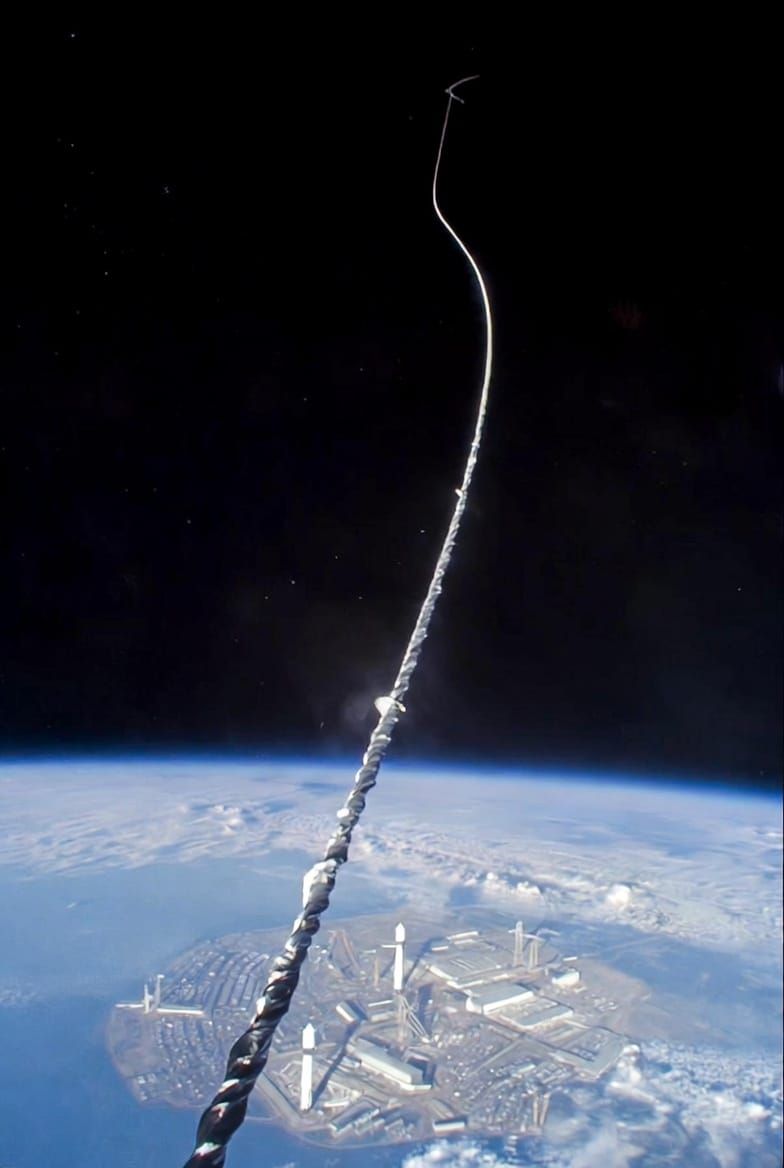
A space tether is a long, strong cable deployed in orbit or extending from a planetary surface. It connects two or more masses (e.g., spacecraft, counterweights, or payloads) and exploits fundamental physics—primarily gravity gradients, centrifugal forces, momentum conservation, and sometimes electromagnetic interactions—to enable propulsion, stabilization, power generation, or transportation with little or no propellant.
Space tethers come in several forms, each working differently. The most discussed types include:
1. Space Elevator (Stationary/Geostationary Tether)
This is the classic "beanstalk" concept: a single, extremely long tether anchored to Earth's equator and extending far beyond geostationary orbit (GEO, ~35,786 km altitude).
- How it stays up: Earth's rotation creates a balance of forces. Gravity pulls downward more strongly on the lower part of the tether (closer to Earth). Above GEO, the centrifugal force (due to the system's rotation with Earth) dominates and pulls outward. A counterweight (e.g., a massive asteroid or extended tether section) at the far end keeps the center of mass above GEO. This tension keeps the entire structure taut and stationary relative to a point on the equator.
- How payloads move: Electric "climbers" (vehicles) crawl up or down the tether using motors powered by solar energy or beamed power. No rockets are needed for the ascent—the tether provides the structure, and Earth's rotation imparts orbital velocity as you rise. At GEO, you can release payloads into geostationary orbit; higher up, you get even more velocity for escape trajectories.
- Physics summary: It defeats much of the rocket equation by avoiding massive propellant use. The tether must have extraordinary specific strength (tensile strength divided by density) — roughly 30–50 times that of steel — to support its own weight under tension. Candidates include carbon nanotubes or graphene-based materials, though none are yet producible at the required scale and length.
- Challenges: Micrometeoroids, atomic oxygen erosion, lightning, and the sheer engineering scale. It would enable cheap, frequent access to space for cargo and eventually people.
2. Momentum-Exchange Tethers (Rotating or "Skyhook" Systems)
These are shorter, orbiting tethers (often tens to hundreds of km long) that act like a giant rotating sling or yo-yo in space.
- How they work: The tether (or a facility with a central body and long cable) rotates around its center of mass while orbiting Earth. A payload in a lower orbit rendezvous with the tether's lower tip (which is moving relatively slowly backward at the moment of catch). The payload latches on, rides the rotation for part of a spin (gaining velocity from the tether's motion), and releases at the upper tip with significantly higher speed and altitude. This transfers orbital momentum from the tether system to the payload.
- Reboost: The tether slows down slightly after each boost, so it uses electrodynamic thrusting (see below) or small ion thrusters to regain energy and altitude over time—often with minimal propellant.
- Variants:
- Rotovator: A fast-spinning tether that can theoretically dip to the surface or low atmosphere for pickup.
- Skyhook: A non-rotating or slowly rotating version hanging from a higher orbit, acting like a partial elevator from LEO upward.
- Advantage: Provides high-thrust-like boosts (hundreds to thousands of m/s Δv) without expending the payload's fuel. Useful for boosting satellites from low Earth orbit (LEO) to GEO, lunar transfer, or interplanetary trajectories.
3. Electrodynamic Tethers (EDTs)
These are conductive cables (often aluminum or copper-coated) that interact with a planet's magnetic field and ionosphere.
- How they generate thrust or power: As the tether moves through Earth's magnetic field, it induces a voltage (motional EMF). If electrons are collected/emitted at the ends (via plasma contactors or hollow cathodes), current flows along the tether. The Lorentz force (interaction of current and magnetic field) then produces thrust—either boosting the orbit (propulsion) or creating drag (for deorbiting). It can also generate electricity by reversing the process.
- Applications: Propellantless orbital adjustment, power generation, or deorbiting space debris. Hybrids combine this with momentum exchange (e.g., MXER tethers) for reboost after payload tosses.
- Direction control: Polarity of the current determines whether it accelerates or decelerates the system.
Key Physics Principles Common to All
- Gravity gradient stabilization: Objects at slightly different altitudes experience different gravitational pulls and orbital speeds. This naturally aligns the tether radially (vertical) and creates tension.
- Conservation of momentum and angular momentum: Tethers can't create energy from nothing—they transfer it between connected masses or convert orbital energy.
- Tension vs. compression: Tethers are always in tension (pulling), which is why strong, lightweight fibers work better than rigid towers.
- Orbital mechanics: Everything must obey Kepler's laws and account for Earth's rotation, atmospheric drag, and perturbations.
Real-World Status and History
Small tethers have flown successfully on Shuttle missions (e.g., TSS-1R deployed ~20 km) and Delta rockets (SEDS experiments up to 20+ km), demonstrating deployment, dynamics, and basic electrodynamic effects. Longer operational systems remain conceptual or in advanced development, with ongoing research into materials, capture mechanisms, and control. As of 2026, progress continues in electrodynamic and hybrid designs, but a full space elevator or large-scale momentum tether is still decades away due to material and safety challenges.
In the context of your previous question about high-pressure water launch systems, a space tether (especially a momentum-exchange or partial skyhook variant) could theoretically complement a ground-based boost by catching a payload at high altitude/speed and swinging it the rest of the way to orbit—reducing the Δv burden on the initial launcher dramatically.
Space tethers offer a tantalizing path to cheaper, more sustainable space access by leveraging orbital mechanics instead of brute-force rocketry. The biggest hurdles are materials science for the tether itself and precise rendezvous/capture in the dynamic orbital environment.