Could a high pressure water system launch a spacecraft into space?
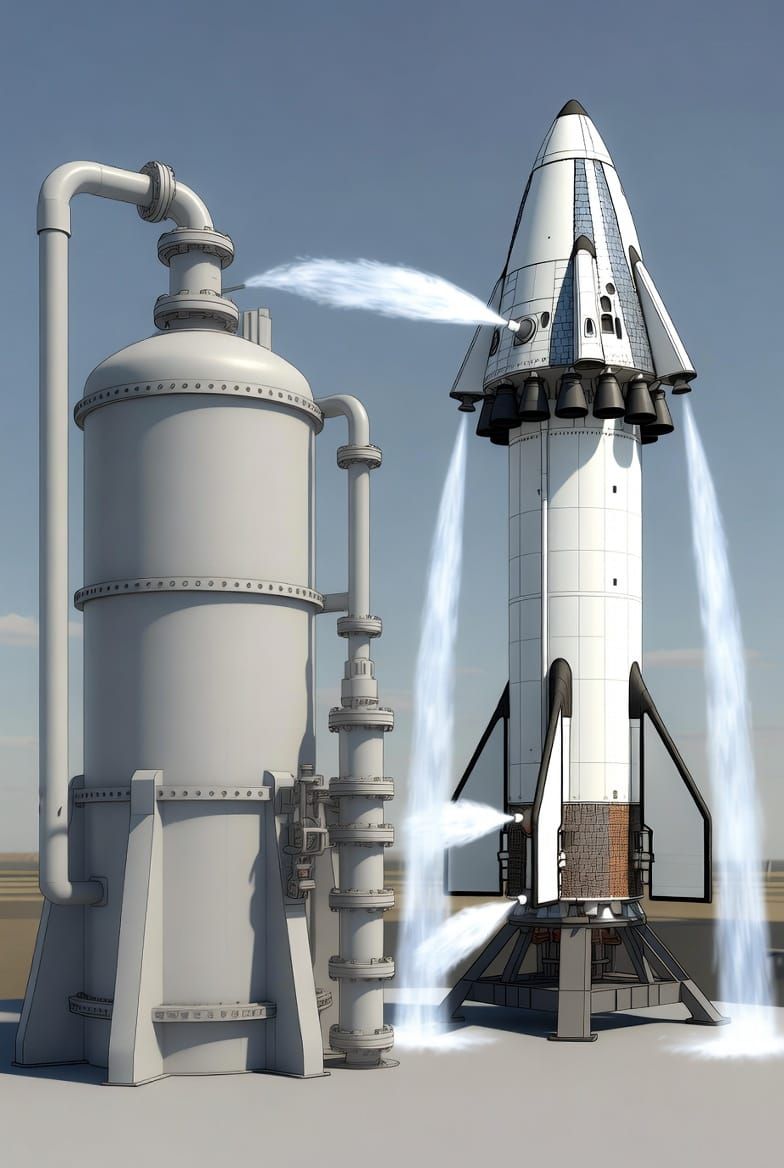
Designing a high-pressure water system to launch a spacecraft beyond Earth's gravitational pull (i.e., achieving escape velocity of ~11.2 km/s or providing a major initial boost toward it) is a purely hypothetical engineering exercise. No such operational system exists or has been seriously prototyped at scale, as confirmed by extensive reviews of aerospace concepts, patents, and research. Existing "water" technologies in rocketry are either tiny hobbyist water rockets (pressurized air expelling water as reaction mass) or launch-pad deluge systems (high-volume water sprays to suppress sound/flames during conventional rocket ignition).
High-pressure water is a poor choice for primary propulsion to space due to physics limits: water is nearly incompressible (good for transmitting force but terrible for sustained expansion like rocket exhaust gases), its exhaust velocity is low (~400–2,000 m/s even when highly pressurized or heated to steam, vs. ~3–4 km/s for chemical rockets), and the energy/mass scales involved are enormous. A pure water-rocket approach requires absurd mass ratios (e.g., propellant mass billions of times the dry mass for escape velocity). A "gun"-style hydraulic launcher requires impractically long barrels or crushing accelerations. Atmospheric drag, heating, and structural issues compound this. In practice, any real system would be a hybrid: high-pressure water for an initial boost to supersonic speeds/high altitude, followed by conventional chemical rockets for the rest of the Δv budget.
Here is how an engineer or team might conceptually design such a system step by step, using a hydraulic "AquaGun" or pressure-assisted piston launcher (the most direct interpretation of "high-pressure water to launch"). This draws from space-gun concepts (e.g., Jules Verne, Project HARP, light-gas guns) but substitutes water for gas as the driving fluid, plus ocean-depth pressure ideas for a variant.
1. Define Requirements and Physics Constraints
- Target performance: Achieve ~11.2 km/s (escape velocity) or a strong initial boost (e.g., Mach 5–10 at high altitude) so onboard rockets handle the rest. Account for gravity/drag losses (~1–2 km/s extra in reality).
- Acceleration limit: For rugged/uncrewed payloads, 100–1,000 g (980–9,810 m/s²). Humans max out at ~10–20 g briefly. Higher g requires massive structural reinforcement.
- Key equation for barrel length (constant acceleration, ignoring drag/gravity):
[ L = v squared over 2a]
Example: For v = 11,200m/s and a = 500g approximating 4,905 m/s², L approximating 12.8km. For 100 g, L approximates 64km (mountain-scale or drilled tunnel). - Pressure required:
[ P = ma\A ]
m = payload + piston mass, A = piston cross-sectional area). Example: 1,000 kg payload, 2 m diameter piston, 500 g → ~2 MPa (~290 psi). Scale up for larger payloads or higher g → tens to hundreds of MPa (thousands of psi), requiring industrial high-pressure pumps/accumulators. - Energy: Kinetic energy alone for 1 ton at 11.2 km/s is ~63 GJ (~17 MWh)—plus huge inefficiencies from water flow, friction, and heat.
Ocean-pressure variant (submerged tube in deep ocean, e.g., 11 km depth): Hydrostatic pressure P = rho g h approximating 110MPa provides initial force via hatches/valves under a sealed platform. Ideal calc yields ~7.3 km/s for a Falcon 9-class vehicle, but real limits (speed of sound in water ~1.5 km/s, cavitation, water drag, air compression/heating in tube) cap it at a tiny fraction of orbital velocity.
2. Core Architecture: Hydraulic Piston Launcher
- Launch tube/barrel: Kilometer-scale vertical or inclined tube (evacuated ahead of piston for minimal air resistance; possibly embedded in mountain or underwater for support). Materials: high-strength steel/composites with internal liners to resist erosion/corrosion from high-velocity water flow. Diameter sized to payload (e.g., 2–10 m).
- Piston/sabot: Spacecraft sits atop a massive, sealed piston/plunger (or sabot that detaches post-launch). Piston transfers water pressure into upward force. Seals must handle extreme pressures/speeds without leaking (e.g., advanced polymer or metal-ring seals).
- High-pressure water system:
- Massive reservoir/accumulators (tanks or the lower tube section) filled with water.
- Pressurization: High-power pumps, gas-over-water bladders (nitrogen/helium at 1,000–10,000+ psi), or even explosive/gas generators for rapid spike. Continuous pumping or staged accumulators to maintain pressure as piston moves (water is incompressible, so volume displacement must be managed).
- Release: Burst disks, fast valves, or explosive diaphragms to suddenly apply pressure.
- Propulsion physics: Water pressure pushes piston upward. As water flows/expands behind it (possibly through nozzles or just as a column), it accelerates the payload. Exhaust water shoots out the bottom—inefficient but functional for short-duration boost.
3. Payload and Vehicle Design
- Spacecraft: Hardened capsule/fairing with g-tolerant electronics, payload (satellites, supplies), and secondary propulsion (chemical rockets or even a small water/steam stage for fine-tuning). Heat shield for atmospheric exit (Mach 10+ causes extreme heating). Guidance: fins, RCS thrusters, or active control.
- Staging/separation: Piston/sabot detaches at tube exit; spacecraft ignites onboard engines.
- Hybrid option: Use water boost to ~Mach 5–8 and 10–50 km altitude, then light chemical upper stages (far more efficient).
4. Infrastructure and Operations
- Site: Deep ocean (for hydrostatic assist) or mountain (reduced air density/atmospheric drag). Mobile barge for ocean variant.
- Power/Pressurization plant: Gigawatt-scale pumps, compressors, and energy storage (or nuclear/renewable for green ops).
- Safety/Control: Redundant pressure relief, structural monitoring, abort systems. Simulate hydrodynamics (CFD for water flow, cavitation, shock waves).
- Recovery/reuse: Piston recoverable; tube reusable with maintenance.
- Testing: Scale prototypes (small tube → hobby water-rocket analogs) → full-scale unmanned tests.
5. Major Challenges and Why It’s Impractical
- Scale and cost: 10–100+ km infrastructure dwarfs current rockets. Energy input rivals small power plants per launch.
- Physics limits: Cavitation/vaporization at high speeds; water drag/heating; speed-of-sound bottleneck in fluid; post-exit atmospheric destruction without heat shielding.
- Efficiency: Water’s low exhaust velocity means poor Δv per mass (rocket equation: Δv = v sub e log of(m sub 0/m sub f; water (v sub e is too low).
- Materials: Tube/piston must survive 1,000s of g, MPa pressures, and thermal shocks.
- Compared to alternatives: Conventional rockets (or emerging space guns using light gas/explosives) are vastly simpler/cheaper. Concepts like Longshot’s pneumatic cannon or maglev assist are closer to reality but still unproven.
In summary, you’d design it as a giant hydraulic ram using pressurized water accumulators to shove a piston-borne spacecraft up an evacuated tube. It might work as a low-cost boost for bulk, rugged cargo (water, fuel, raw materials), but never as a standalone replacement for chemical rockets to escape Earth’s gravity. Real-world space access favors rockets or future non-rocket concepts like space elevators/tethers.