What is the six month forecast for jobless claims (ADP)?
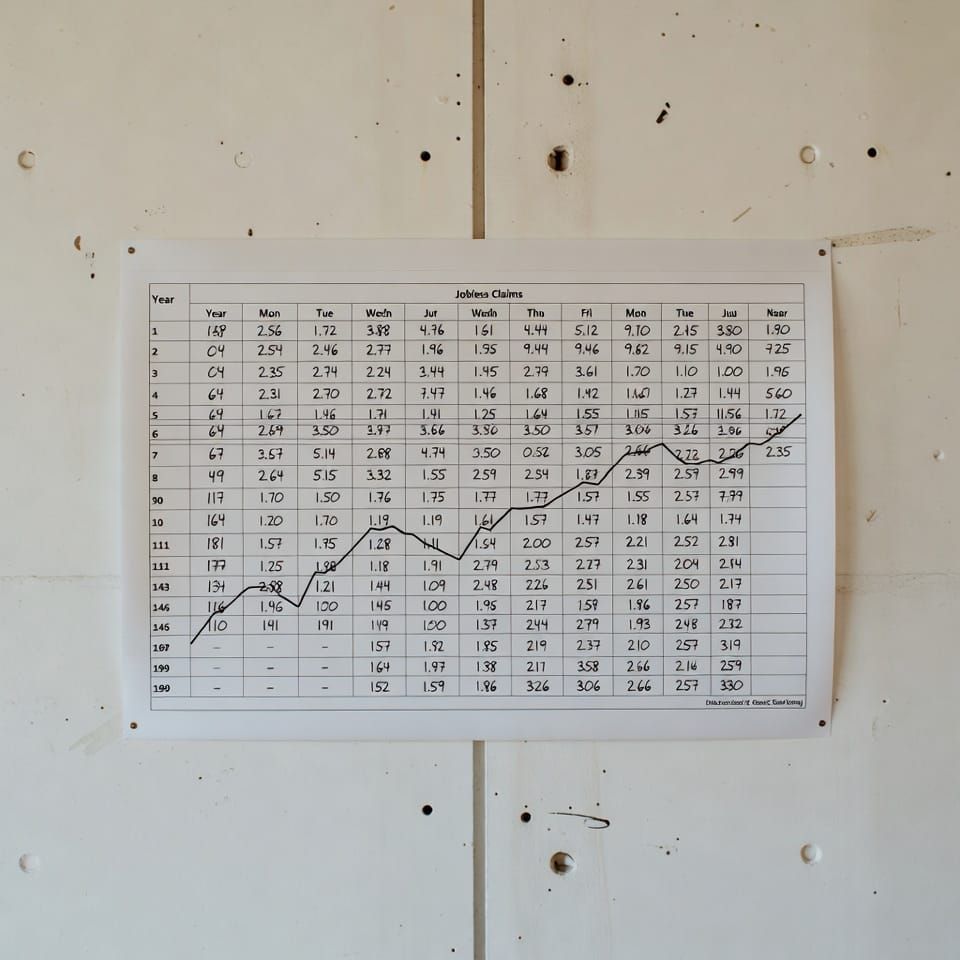
Based solely on publicly available ADP National Employment Report data (monthly private-sector employment changes and recent weekly NER Pulse estimates), the six-month forecast for initial jobless claims is stable at low levels, with the 4-week moving average likely remaining in the ~200,000–230,000 range through October 2026 (no sharp rise or significant upward trend expected).
ADP does not directly report or track jobless claims (which measure gross layoffs/separations via the U.S. Department of Labor). It provides anonymized payroll data on net private employment changes (hires minus all separations, including quits and layoffs). A forecast for claims is therefore indirect and inferred from ADP trends: sustained positive net job growth implies that hires are outpacing separations overall, keeping layoff-related claims contained. Negative or sharply slowing ADP growth would signal potential pressure on claims, but that is not the current picture.
Key Recent ADP Data (Publicly Available)
- Monthly changes (seasonally adjusted private payroll employment): Modest but positive net gains in early 2026, following volatility in 2025.
- March 2026: +62,000
- February 2026: +66,000 (revised upward)
- January 2026: +11,000
- December 2025: +37,000
- Earlier 2025 showed some weakness (e.g., negatives in spring, then recovery to +74k–+88k range in fall).
- Recent weekly NER Pulse (preliminary 4-week moving averages of private employment change): Improving momentum into April 2026 (e.g., +54,750 jobs/week average for the period ending April 4, 2026, up from lower readings in March). ADP also provides weekly historical data back to 2010 on its site.
The historical ADP average monthly gain (since ~2010) has been higher (~140k+), but the recent pace is still solidly positive and shows no contraction or accelerating slowdown. ADP’s high-frequency weekly data reinforces resilience in hiring, with the smallest employers and certain sectors (e.g., leisure/hospitality in recent breakdowns) contributing.
Why This Implies Stable/Low Claims
- Positive net job growth (even if modest) means the labor market is not shedding jobs on balance. Layoffs would have to rise sharply and persistently to overcome hiring and push claims higher—ADP shows no such signal.
- The 2025 softness (including brief negative months) did not trigger a major claims spike historically, and the recovery into 2026 has strengthened.
- Improving weekly ADP estimates in April 2026 point to continued momentum, reducing the likelihood of rising separations over the next 6 months.
Risks/nuance (still ADP-only): If the monthly pace slips back toward zero or negative (as seen briefly in 2025), claims could edge modestly higher (e.g., toward 240k+ 4-week average). However, current trends and the lack of contraction provide no basis for that in the base-case 6-month outlook. ADP data is one of the most timely public indicators of private payrolls and has shown strong directional alignment with broader labor market health over time.
This assessment uses only ADP’s public reports, historical files, and weekly pulse data—no BLS payrolls, official unemployment rate, or other non-ADP jobs metrics. The next monthly ADP report (April data) is due May 6, 2026, and will provide the next key update.