Why are the regulation basketball and the regulation hoop that size?
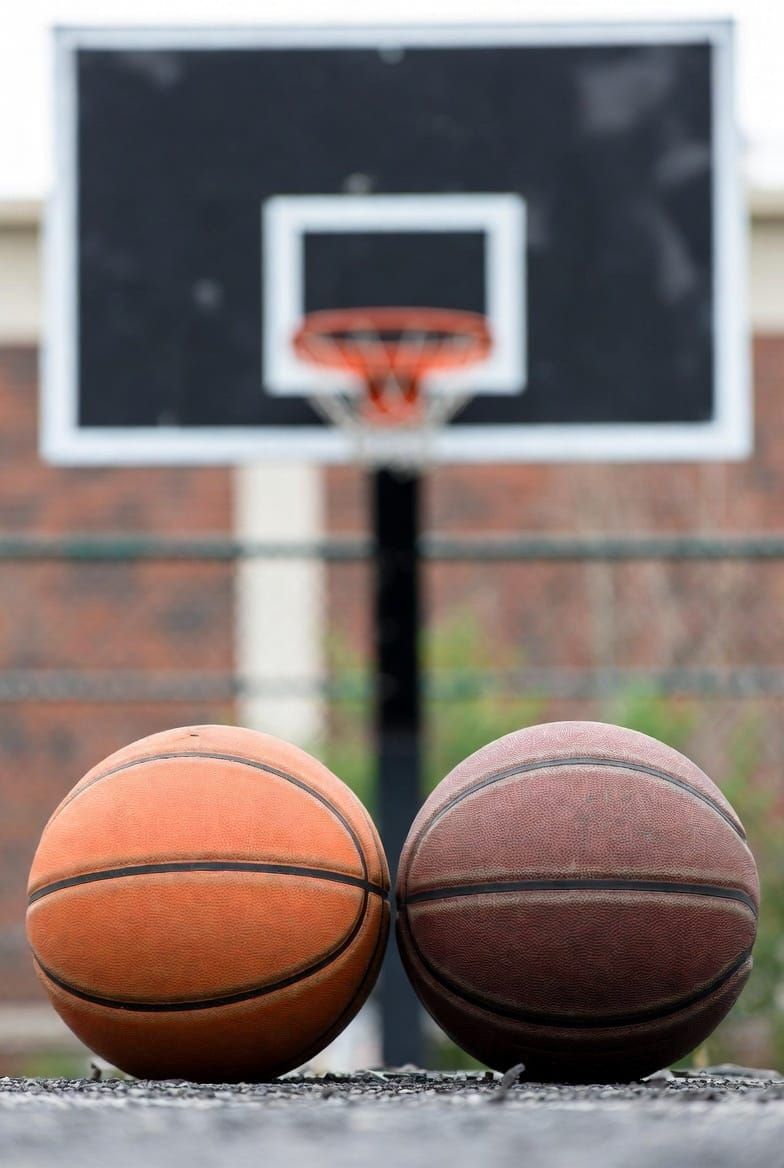
The hoop (rim) size has remained essentially unchanged since James Naismith invented basketball in 1891, while the ball has gotten slightly smaller over time. This means the ball is now a bit smaller relative to the hoop compared to the earliest days of the game.
Hoop (Rim) Size
- Original (1891): Naismith used ordinary peach baskets nailed to a 10-foot-high railing. These were not standardized metal rims. A typical peach basket had an opening roughly 18–20 inches in diameter (or slightly wider at the top), though exact measurements varied because they were everyday produce baskets. The bottom was closed, so someone had to retrieve the ball after every made shot (often with a ladder or pole).
- Early evolution (1890s–1910s): Peach baskets were quickly replaced by metal rims (woven wire in 1892, cast iron around 1893) with open bottoms and nets. The rim diameter was standardized to 18 inches (inside diameter) by the 1930s at the latest, and it has stayed exactly that size ever since in all major rule sets (NBA, NCAA, FIBA, high school, etc.).
- Today: Regulation hoop is 18 inches (45.72 cm) inside diameter, mounted 10 feet (3.05 m) above the floor. The height has never changed. Modern rims include features like breakaway mechanisms for safety, but the diameter is identical to the standardized metal rims used for over 90 years.
The target size has been stable at 18 inches for the vast majority of basketball's history.
Basketball (Ball) Size
- Original (1891): The first game used a soccer ball (association football). Late 19th-century soccer balls typically had a circumference of about 30–32 inches (roughly 9.5–10.2 inches in diameter), though they varied because they were hand-stitched leather with a rubber bladder and often had laces.
- Early official rules (1890s): By 1896–1897, rules specified the ball should be round rubber/leather with a circumference between 30 and 32 inches (no smaller than 30", no larger than 32"). This was slightly larger and more variable than today's balls. Early purpose-built basketballs (starting ~1894 by Spalding) were similar in size but heavier and less spherical due to stitching.
- Key changes:
- 1920s–1930s: Balls were redesigned for better bounce and concealed laces; they remained relatively large.
- 1942–1949: Molded (seamless) basketballs were introduced, which held shape better. A molded version with a 30-inch circumference became official around 1949.
- Modern era: The ball was refined further for consistency, grip, and visibility (orange color became standard in the 1950s).
- Current regulation sizes (men's/professional level):
- NBA (men): 29.5 inches circumference (about 9.39–9.51 inches diameter), weight 20–22 oz.
- FIBA/international (men, Size 7): 29.5–30.3 inches circumference.
- Women's (WNBA/NCAA): Slightly smaller at ~28.5 inches circumference (~9.07–9.22 inches diameter).
The ball is now more consistent, lighter relative to its size in some ways, more spherical, and easier to grip/dribble thanks to better materials (leather or composite).
How the Relative Size Has Changed
- Early days (1891–1940s): Ball circumference was often 30–32 inches (diameter ~9.5–10.2 inches) against a hoop of ~18 inches (or slightly variable peach basket). The ball was closer in size to the hoop opening, making precise shooting potentially a bit harder or different in feel. The ball-to-hoop diameter ratio was roughly 1:1.8 to 1:1.9 (hoop almost twice the ball's diameter).
- Today: Men's ball ~29.5 inches circumference (~9.4 inches diameter) vs. 18-inch hoop. The ratio is about 1:1.92 (hoop is a bit more than 1.9 times the ball's diameter). The ball is marginally smaller relative to the hoop than in the very earliest standardized rules.
The change is small — only about 0.5–2.5 inches less in circumference from the upper end of early specs — but noticeable in terms of consistency and playability. The hoop has not shrunk or grown; any perceived "easier" shooting today comes more from better balls, athleticism, training, and rules changes (e.g., shot clock, three-point line) than from equipment size shifts.
Visually, even today you can fit roughly 1.9 balls side-by-side across the rim's diameter, but not two full balls through at once due to the ball's spherical shape and the rim's thickness.
Overall, basketball equipment has evolved for better performance and uniformity, but the hoop diameter has been one of the most constant elements since the transition from peach baskets to metal rims in the 1890s. The game has changed far more in style, rules, and player skill than in the core target-to-projectile sizing.